Championship Fixed Before It Even Starts? The Hidden Mercedes Trick the FIA Doesn’t Want to Stop
Is it legal because it complies with the spirit of the regulation, or because the regulation does not know how to prove that it doesn’t?
 Alberto Maroto ZamoranoVelocidad Total
On the eve of the Australian Grand Prix, the feeling in the paddock is not one of technical uncertainty, but of moral discomfort. Because what is at stake with the so-called “compression trick” of the Mercedes-AMG Petronas Formula One Team is not merely a clever interpretation of the regulations, but the credibility of officiating in modern Formula 1.
It has been repeated ad nauseam that the Mercedes engine “is legal.” And it probably is. But this is where the real debate begins: is it legal because it complies with the spirit of the regulation, or because the regulation does not know how to prove that it doesn’t?
The Temperature Trap
At the heart of the conflict lies how the engine’s compression ratio is measured. Following the technical annexes approved on October 14, the FIA made it clear that compliance checks would be carried out under “ambient” conditions. In other words, cold.
The problem? A Formula 1 engine does not race cold.
If a manufacturer finds a way for its power unit to comply with the 16:1 ratio under laboratory conditions, but exceed that figure in real operating conditions thanks to controlled thermal expansion or other engineering solutions, is it breaking the rules? Technically, no. From a sporting perspective, it is debatable.
And here comes the uncomfortable parallel: in law, if there is insufficient evidence, the presumption of innocence prevails. No one can be convicted without solid proof. But sport is not a criminal court; it is a competition based on regulatory equality. If the FIA does not have — or does not want to have — the means to verify what happens when the engine is hot, the loophole does not morally absolve the advantage obtained.
Shifting Narratives and Suspicious Timing
From October to pre-season testing, Mercedes’ discourse has evolved. First, a firm defense of legality. Then, technical collaboration with the FIA. Later, tacit acceptance of a new hot testing procedure… but only from August 1 onward.
Coincidence? That means the Mercedes-AMG Petronas Formula One Team, along with its customers McLaren F1 Team, Williams Racing and Alpine F1 Team, could contest more than half the season with a concept that rivals consider contrary to the spirit of the regulations.
If the new hot test is necessary, it is because the current one is insufficient. And if it is insufficient, the obvious question arises: why allow that insufficiency to decide the championship over 13 races?
Equality or Political Management?
Formula 1 presents itself as the technological pinnacle of sport. But it is still sport. And in sport, equal conditions must be the starting point. The difference should be made by the drivers… within a fair technical framework.
If a team interprets the rules to the extreme and the FIA takes months to react, the message is dangerous: risk pays off.
It would be like discovering that a football team is using a ball with irregular characteristics, but allowing it to continue using it until mid-season while a better measurement method is developed. The scandal would be immediate.
Here, however, it is normalized.
The Referee Is Also Playing
The FIA is not a spectator. It is the referee. And when the referee changes the measurement criteria mid-season, it is implicitly acknowledging that the previous system was insufficient.
The worrying part is not the introduction of a hot test. The worrying part is the timing of its application.
If legality can truly be verified under hot conditions, it should be done before results have irreversible consequences. Because if in August it is discovered that an advantage existed, the competitive damage will already have been done.
This is not about punishing innovation. Formula 1 thrives on innovation. It is about preventing innovation from succeeding solely because the regulator failed to foresee how to measure it.
A Dangerous Precedent
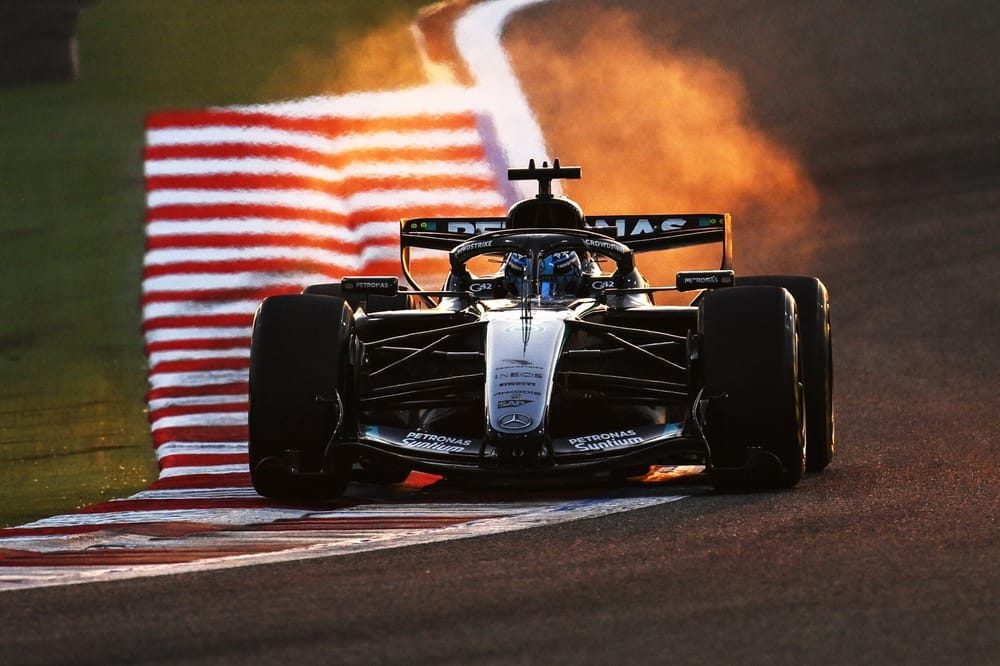
Allowing a technical loophole to determine half a season sets an uncomfortable precedent for the 2026 regulations. What prevents another manufacturer from exploiting a similar grey area, knowing that institutional reaction will be slow and negotiated?
Paradoxically, the attempt to “close the issue” may actually be triggering an even more aggressive development race. Because if the message is that legality depends on inspection capability rather than the spirit of the rule, engineering will focus on the invisible limit, not the written one.
And that turns the championship into a legal battle rather than a sporting one.
A Season Already Conditioned
To say the result is decided would be an exaggeration. To say it is not conditioned would be naive.
If a concept delivers a substantial gain in efficiency or power during the first half of the year, that cushion may be enough to build a strategic and psychological advantage that cannot be neutralized later.
The problem is not Mercedes. The problem is the system.
Because when the regulatory authority has the budget, technology, and time to verify something, but chooses to postpone verification, it stops being a technical matter and becomes a political one.
And in Formula 1, politics always ends up influencing the stopwatch.
The big question is not whether the engine is legal today. The big question is whether the championship will be fair tomorrow.